Welcome to Robotext
Physical AI Education Platform
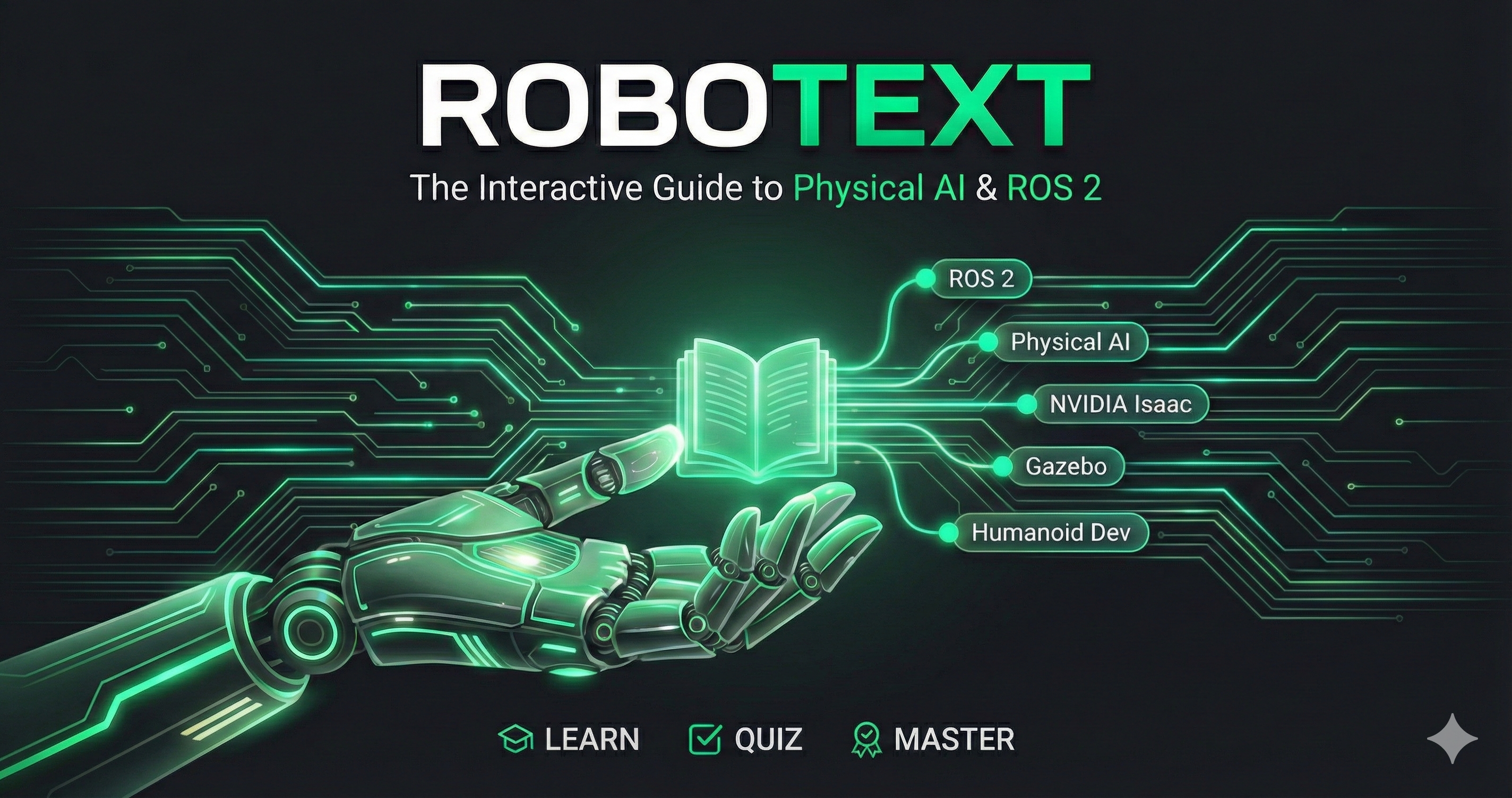
Welcome to Robotext — your comprehensive, AI-native learning platform for Physical AI, humanoid robotics, and embodied intelligence. Designed to bridge the gap between theoretical AI and real-world application, this course takes you from foundational concepts to building advanced, autonomous humanoid robots.
This isn't just a textbook; it's a hands-on journey into the future of intelligent machines.
🚀 What You Will Learn
- ROS 2 Fundamentals: Master the Robotic Operating System (ROS 2), the industry standard for robot control.
- Digital Twins & Simulation: Build and test robots in high-fidelity simulators like Gazebo before deploying to hardware.
- NVIDIA Isaac Platform: Leverage GPU-accelerated perception and simulation for next-gen robotics.
- Vision-Language-Action (VLA): Create robots that understand the world through vision and language to execute complex actions.
- Humanoid Robotics: Design and program bipedal robots capable of navigating human environments.
🤖 The Future of Work
The future of work is a partnership between humans, AI agents, and physical robots. Physical AI represents the next great frontier—giving AI a body, senses, and the ability to interact with the physical world.
Why Physical AI Matters
Traditional AI lives in servers, processing data. Physical AI lives in the real world, perceiving environments through sensors, making real-time decisions, and taking actions through actuators. This embodied intelligence is revolutionizing industries from healthcare and manufacturing to logistics and home assistance.
📚 Comprehensive Learning Path
Our curriculum is organized into 4 progressive modules spanning 13 weeks, covering the entire stack of modern robotics:
Module 1: The Robotic Nervous System (ROS 2)
Weeks 1-5 | Foundation
Learn the core framework that connects sensors, brains, and muscles. You will master ROS 2 architecture, nodes, topics, services, and advanced communication patterns.
- Week 1: Introduction to Physical AI
- Week 2: The Physical AI Landscape
- Week 3: ROS 2 Architecture & Graph
- Week 4: Topics, Services & Actions
- Week 5: Advanced ROS 2 Patterns
Module 2: The Digital Twin (Gazebo)
Weeks 6-7 | Simulation
Build virtual replicas (Digital Twins) of your robots to test algorithms safely and cost-effectively. Master URDF modeling, physics simulation, and sensor integration in Gazebo.
- Week 6: Simulation Fundamentals
- Week 7: Advanced URDF & World Modeling
Module 3: The AI-Robot Brain (NVIDIA Isaac™)
Weeks 8-10 | Intelligence
Leverage GPU-accelerated AI for real-time perception, navigation, and manipulation. Learn to use the NVIDIA Isaac platform for high-performance robot autonomy.
- Week 8: Introduction to Isaac Platform
- Week 9: Isaac SDK & Perception Pipelines
- Week 10: Advanced Navigation & Manipulation
Module 4: Vision-Language-Action (VLA)
Weeks 11-13 | Advanced Integration
Create robots that can perceive, reason, and chat. This module focuses on multi-modal AI models that combine vision and language to drive physical actions, culminating in a capstone project.
- Week 11: Humanoid Development
- Week 12: Multi-modal VLA Models
- Week 13: Capstone: Conversational Humanoid Robot
🎓 Learning Approach
This course follows a progressive complexity model:
- Phase 1 (Weeks 1-2): Fundamental concepts and the "Why" of Physical AI.
- Phase 2 (Weeks 3-10): Core technical skills (ROS 2, Gazebo, Isaac) and the "How".
- Phase 3 (Weeks 11-13): Advanced integration, VLA models, and the "What's Next".
Each week includes:
- 📖 Theory: Clear, in-depth explanations of concepts.
- 💻 Hands-on Code: Python and C++ examples you can run.
- 🎨 Visuals: Architecture diagrams and flowcharts.
- ✅ Assessments: Quizzes and challenges to test your knowledge.
🛠️ Prerequisites
To get the most out of this course, you should have:
- Programming: Comfort with Python (loops, functions, classes). C++ basic knowledge is a plus.
- System: Familiarity with Command Line/Terminal basics.
- Math: Basic understanding of algebra and linear algebra (vectors, matrices).
- Mindset: A passion for building the future!
Note: No prior robotics experience is required. We start from first principles and guide you step-by-step.
Ready to Begin?
Start your journey into the world of Physical AI:
Start Module 1: Robotic Nervous System
Let's build the future of Physical AI together! 🚀